A soothing balm should feel simple on a baby’s skin: a thin, even layer, no strong scent, and no complicated ingredient list. Yet choosing one is not always obvious. “Natural” does not automatically mean gentle, and a rich balm may feel uncomfortable on warm, damp skin. A useful principle, paraphrasing pediatric dermatologist Dr. Lawrence Eichenfield’s guidance on infant skin care, is: “Keep care gentle, simple, and suited to the child’s needs.” This is a paraphrase, not a verbatim quotation.
A careful Soothing baby balm formulation usually prioritizes a protective base and a short, clearly disclosed list of ingredients. The label matters. Check for fragrance, known allergens, and directions for use; ask a pediatric clinician about ingredients if your baby has eczema, broken skin, or a history of reactions. A small patch test may help identify irritation, but it cannot guarantee that a product will suit every baby. Watch for redness or discomfort. Stop use if a reaction appears.
This guide will compare balm textures, ingredient choices, packaging, and practical safety checks, so caregivers can make a more informed decision. It will also explain what a balm can—and cannot—do: soothing dry-feeling skin is different from treating a medical condition. There is no perfect formula for every family. Sometimes the honest answer is that more information, or a clinician’s advice, is needed.
Define the Infant Use Case and Confirm the Balm Is a Leave-On Product
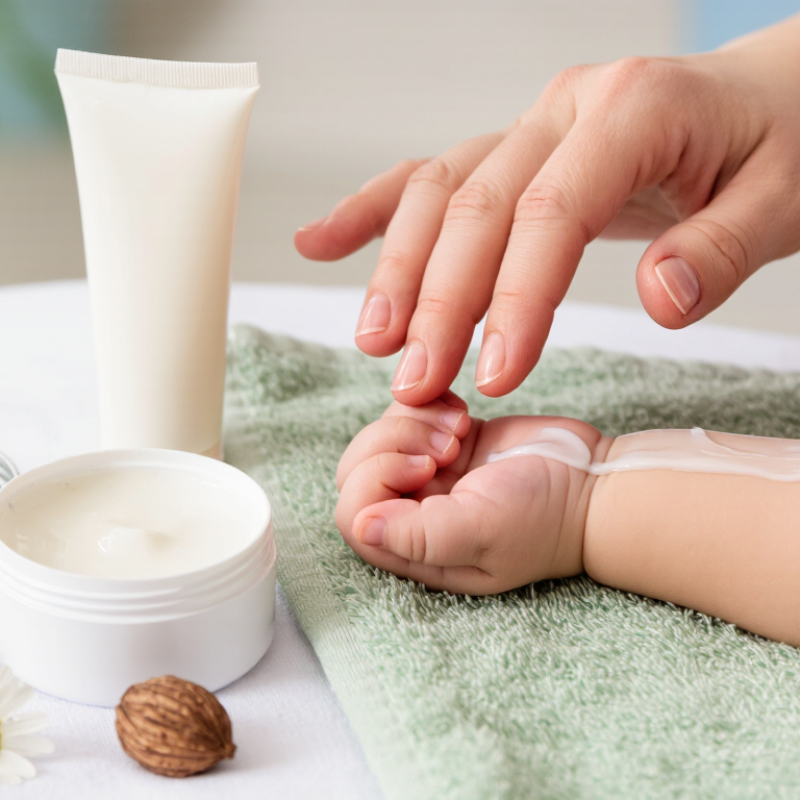
Define the infant use case before comparing oils or waxes. Is the balm for dry cheeks, rough limbs, or diaper-area skin? These uses involve different body sites and application patterns. A balm is a leave-on product when it stays on the skin instead of being rinsed away. That distinction matters. Continued contact can mean transfer to clothing, hands, or nearby surfaces.
The National Eczema Association’s Eczema Facts and Statistics page reports that about 60% of people with eczema develop it during their first year. This is useful context, not a diagnosis: an infant’s dry patch is not automatically eczema, and a balm should not be presented as a cure. Record the baby’s age, application site, skin condition, and how often the product will be used. If skin is broken, weeping, or worsening, seek advice from a pediatric health professional before applying a new product.
Check that the directions clearly identify the product as a leave-on balm, with an age range, amount, frequency, and areas to avoid. Consider where it will be stored and whether a caregiver might apply more than intended. “Gentle” alone is not a use case. I would not assume that a soothing claim answers the practical questions; that shortcut deserves a second look.
Select Emollients and Occlusives to Support the Skin Barrier
A soothing baby balm should combine emollients, which soften dry skin, with occlusives that slow water loss. Think of emollients as smoothing tiny rough patches, while an occlusive layer helps shield the skin. A 2011 review in Pediatric Dermatology reports that an infant’s surface-area-to-body-weight ratio can be about 2.3 times an adult’s. That makes gentle barrier care especially practical. Keep it simple.
Look for a short, fragrance-free formula with suitable emollients, such as plant oils or skin-identical lipids, and an occlusive such as petrolatum or dimethicone. The best texture depends on where it is used: a richer balm may suit dry cheeks, while a lighter layer feels less sticky in skin folds. Ingredients alone do not guarantee a good fit. Stop using the balm if irritation appears, and ask a clinician about persistent rashes.
Tips: Patch-test a small area first. Apply a thin layer to clean, slightly damp skin, then check for redness or discomfort. No formula works for every baby; that uncertainty matters.
How to Choose a Soothing Baby Balm Formulation - Select Emollients and Occlusives to Support the Skin Barrier
| Ingredient or component |
Primary formulation role |
Illustrative starting level (% w/w) |
Selection and formulation considerations |
| Petrolatum |
Strong occlusive; helps reduce water loss from the skin surface. |
20–50% |
Can create a protective, greasy-feeling film. Adjust the level to balance barrier coverage, spreadability, and desired texture. |
| Sunflower seed oil |
Liquid emollient; softens skin and contributes to the oil phase. |
10–30% |
Choose a suitable cosmetic-grade oil and assess oxidation stability. Plant oils vary in composition and should not be assumed to suit every infant. |
| Shea butter |
Emollient and balm structuring component; adds body and a cushiony skin feel. |
5–20% |
Its firmness and sensory profile vary by grade and processing. Test for graininess, melting behavior, and consistency across temperature conditions. |
| Beeswax |
Structuring agent that increases firmness and helps form a surface film. |
3–10% |
Higher levels generally produce a firmer, more drag-resistant balm. Consider a suitable alternative wax if beeswax is not appropriate for the product brief. |
| Dimethicone |
Skin-conditioning silicone that can help form a smooth, water-resistant protective film. |
1–5% |
Check compatibility with the other ingredients and applicable local rules for the product’s intended use and claims. |
| Tocopherol |
Antioxidant for helping protect oxidation-prone oils in the formula. |
0.05–0.5% |
It is not a substitute for a preservative. Confirm the appropriate level with stability testing and the supplier’s guidance. |
| Fragrance and essential oils |
Optional scent ingredients; not required for the balm’s emollient or occlusive function. |
Preferably 0% |
A fragrance-free design can help limit avoidable fragrance exposure. Any optional fragrance ingredient requires appropriate safety assessment and regulatory review. |
Formulation note: The percentages are illustrative starting ranges, not a finished formula or universal recommendations; they should not be combined at their maximum levels. Select amounts that total 100% w/w, then assess texture, stability, ingredient quality, and product safety. An anhydrous balm may not need the same preservation approach as a water-containing product, but microbial quality and packaging still require assessment. Have the finished product evaluated for its intended use and applicable regulations.
Check EU Fragrance-Allergen Labeling at 0.001% for Leave-On Products
How to Choose a Soothing Baby Balm Formulation
A baby balm stays on the skin, so fragrance details deserve careful attention. Under EU cosmetics rules, listed fragrance allergens must be declared individually when they exceed 0.001% in a leave-on product.
That is 10 milligrams per kilogram of finished balm. The threshold is a labeling requirement, not a guarantee that a formula will suit every baby.
When reviewing a formula, check the ingredient list for individually named allergens, not just “parfum” or “fragrance.” Ask the manufacturer for current ingredient and supplier documentation, especially if the fragrance blend has changed. A familiar scent can contain several components. Small amounts matter.
For a soothing balm, a simple, low-fragrance formula may be easier to assess, but “unscented” wording alone tells you little about the full ingredient profile. Check the complete label and seek professional advice if a baby has known sensitivities.
That detail matters. Labels can be dense, and I would not treat a tidy ingredient list as proof of zero irritation risk. Verify current EU requirements, too, since allergen lists and transition dates can change.
Meet ISO 17516’s 10² CFU/g Microbial Limit for Products for Children Under 3
How to Choose a Soothing Baby Balm Formulation
Meet ISO 17516’s 10² CFU/g Microbial Limit for Products for Children Under 3
A baby balm should feel gentle, but softness is only one part of the formulation. For cosmetics intended for children under three, ISO 17516 sets a microbial limit of 10² CFU/g or mL for total aerobic mesophilic microorganisms. The standard also calls for specified microorganisms, including E. coli and Staphylococcus aureus, to be absent in a tested sample. These are measurable criteria, not a promise that a product is risk-free.
A balm’s low water content may make microbial growth less likely, but it does not replace testing. Contamination can enter through raw materials, filling equipment, or repeated finger contact with an open jar. A qualified laboratory can test the finished product using appropriate methods. Packaging matters, too. A tube or pump can limit contact better than a wide-mouth container. Small details count.
Formulators should assess preservation needs, ingredient quality, manufacturing hygiene, and package compatibility together. A soothing feel does not prove microbial quality. Nor does a passing result alone settle every safety question. That distinction is easy to miss. I would also avoid assuming that “natural” ingredients are automatically gentler or safer; the evidence depends on the specific ingredient and use. Review test results and safety assessments with qualified professionals before choosing a balm for a young child.
How to Choose a Soothing Baby Balm Formulation
ISO 17516 microbial limits for cosmetic products (CFU/g)
ISO 17516 sets a maximum total viable microorganism count of 10² CFU/g for Category 1 cosmetics, which includes products specifically intended for children under three. The Category 2 limit shown for comparison is 10³ CFU/g. Specified microorganisms must also be absent; meeting the count limit alone does not establish product safety.
Validate Preservation and Stability Using ISO 11930 and Packaging Tests
For a soothing baby balm, preservation performance must be measured, not inferred from a clean appearance. ISO 11930:2019 sets out a preservative efficacy test for evaluating antimicrobial protection in cosmetic products. Under Criterion A, the test calls for at least a 3-log reduction in bacteria by day 7, and at least a 1-log reduction in yeast by day 7. For mold, the target is at least a 1-log reduction by day 14, with no subsequent increase through day 28. These are demanding benchmarks. Confirm the laboratory’s organisms, method, and acceptance criteria before testing.
Stability needs its own plan. ISO/TR 18811:2018 guides cosmetic stability testing but does not prescribe one universal protocol. Track balm texture, odor, color, and weight across temperature cycles and real-time storage. A smooth sample can still hide separation or preservative weakness. That can mislead.
Packaging can change the result. Test the finished balm in its intended tube or jar, including seal integrity, leakage, dispensing, and compatibility after storage. Repeat microbial assessment when packaging or use conditions could affect contamination risk. Record the test duration and conditions; do not present accelerated aging as a guaranteed shelf-life prediction. Small details matter, such as balm collecting around a cap or a jar being opened with damp fingers. Sources: ISO 11930:2019; ISO/TR 18811:2018.
Conclusion
A Soothing baby balm formulation should begin with a clear infant-use case and confirmation that the product is intended to remain on the skin. This helps guide choices for texture and use instructions. Emollients can soften and condition the skin, while suitable occlusive ingredients help reduce moisture loss and support the skin barrier. Ingredients should be selected with infant skin in mind, and the finished balm should be assessed for suitability and tolerability.
Quality checks are equally important. For leave-on products in the EU, fragrance allergens may require labeling when present above the 0.001% threshold. Products intended for children under three should meet the ISO 17516 microbial limit of 10² CFU/g. Preservation efficacy can be evaluated using ISO 11930, alongside stability assessments and packaging tests to check that the product remains protected and performs as intended throughout its shelf life.