Engineered to comply with stringent US 3-A, USDA, and cGMP standards. High-throughput continuous and batch systems deployed directly across Illinois manufacturing hubs.
The Greater Chicago metropolitan area—spanning Cook, DuPage, Will, and Lake Counties—stands as the undisputed central logistical and processing heartbeat of North America. As the convergence point for six Class I railroads, interstate transport arteries, and massive distribution centers from O'Hare to the inland port at Joliet/Elwood, Chicago requires manufacturing support capable of handling extreme scale, stringent regulatory demands, and volatile production tempos. In today's hyper-competitive specialty chemicals, personal care, nutraceutical, and commercial food manufacturing sectors, relying on stock, off-the-shelf blending units often leads to unacceptable cross-contamination rates, subpar batch uniformity, and extended cleaning downtime.
As an established China-based custom blending machinery manufacturer and end-to-end processing equipment supplier, we deliver tailored engineering solutions that eliminate these systemic operational bottlenecks. By integrating precision CNC tolerances, food-grade sanitary metallurgy (AISI 304/316L), automated PLC load cell metering, and optimized fluid dynamic agitation profiles, our blending systems bridge global capital equipment cost efficiencies with Midwestern processing rigor.
Industrial mixing is not merely agitation; it is the controlled application of shear stresses, fluid dynamics, and thermodynamic equilibrium. In high-solids blending, powder-liquid induction, and abrasive slurry formulation, improper impeller geometry causes dead zones, localized heat build-up, and shear-induced molecular degradation.
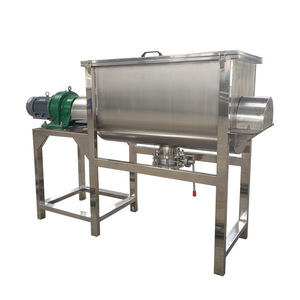
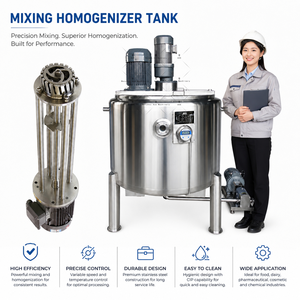
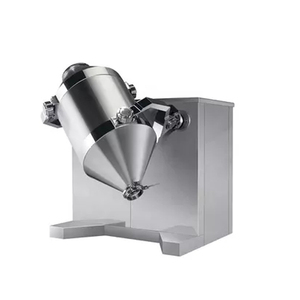
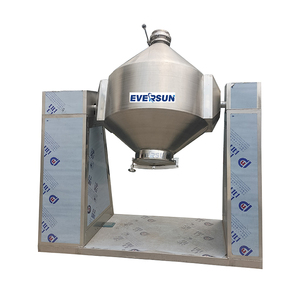
Our specialized equipment range features dual-flight counter-current ribbon agitators designed with inner-to-outer pitch ratios specifically calculated to minimize cycle times while ensuring a coefficient of variation (CV) under 3%. For fragile powders, micro-nutrients, and cosmetic active ingredients, our rotary 3D motion blenders and tumble double cone mixers provide zero-shear diffusion, eliminating attrition or particle size reduction. Conversely, our 1000L chemical homogenizers utilize high-shear rotor-stator systems capable of reducing droplet sizes below 2 microns for stable, micro-emulsified creams, surfactants, and industrial chemical suspensions.
| Equipment / Mixing Topology | Material Phase Dynamics | Target Viscosity / Bulk Density | Chicago Industry Direct Applications |
|---|---|---|---|
| Counter-Current Ribbon Blender (100–600L+) | Solid-Solid / Low-Viscosity Liquid Addition | 0.3 to 1.8 g/cm³ / Up to 15,000 cps | Food dry seasoning mixes, dry mortar, detergent base compounding, sports nutrition powders. |
| Sanitary Double Cone Blender | Dry Granular / Friable Powder Phase | 0.2 to 2.2 g/cm³ bulk density | Nutraceutical tablets, active pharmaceutical dry-fills, metallic powdered metallurgy. |
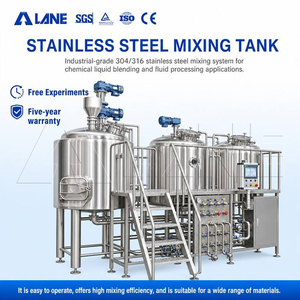
| High-Shear Chemical Agitator Vessel (1000L) | Liquid-Liquid / Liquid-Suspended Solid Emulsion | 100 to 120,000 cps (with scraper) | Household disinfectants, industrial sealants, automotive fluids, clean cosmetic skincare. |
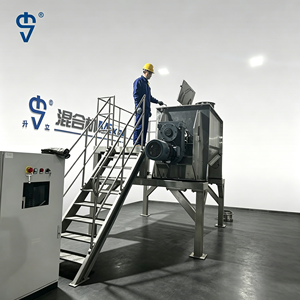
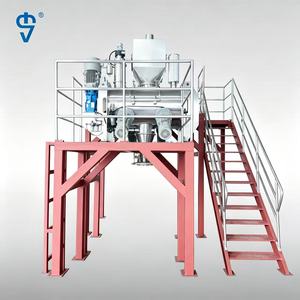
| Integrated Platform Processing System | Continuous Pneumatic Feeding to Bagging | Multi-phase variable control | High-throughput contract toll blending and primary distribution hubs in DuPage & Will Counties. |
Contract packers and toll blenders in the Chicago metropolitan area frequently run several dozen distinct formulations per month across a single processing line. Under traditional designs, mechanical shaft seal failure and impeller crevices present recurring risks of microbial harborage, allergen cross-contact, and volatile solvent leakage.
To meet strict FDA, USDA Organic, and EPA sanitary mandates, our vessels incorporate sanitary split-packing or air-purged labyrinth mechanical seals. All internal product-contact surfaces undergo precision mechanical polishing down to Ra < 0.4 µm, followed by electrochemical passivation to eliminate microscopic pitting. Fully integrated Clean-In-Place (CIP) 360-degree rotating spray balls ensure complete validation-ready sanitation in under 30 minutes, drastically accelerating line changeovers and protecting your plant against costly batch rejection.
Tailored custom blending machinery configured for the specialized needs of Illinois's major manufacturing hubs, chemical processing corridors, and co-packing centers.
Installed across primary food manufacturing corridors along I-55 and the West Suburbs. Our zero-residue 3D powder mixers and sanitary ribbon blenders guarantee uniform vitamin premix dispersion down to parts-per-million (PPM) concentrations without denaturing heat-sensitive biological enzymes.
Serving the heavy manufacturing and specialty solvent facilities in the Calumet Industrial Corridor and Will County. Explosion-proof (Class I, Div 1/2) chemical mixing tanks equipped with variable frequency turbine agitators accommodate extreme shear and exothermic chemical reactions safely.
Ideal for agile co-packers serving Midwest retail networks. Our jacketed homogenizer kettles provide automated thermal ramping and vacuum deaeration, delivering crystalline clear gels, micro-emulsion serums, and stable cosmetic lotions ready for high-speed automated tube or bottle filling.
How automation, clean-label reformulations, and nearshoring pressures are redefining processing requirements across the Chicago region.
Midwest personal care and baby brand consumers demand the elimination of heavy stabilizing polymers and synthetic preservatives. Formulating clean lotions, barrier balms, and organic surfactants requires significantly tighter mechanical shear controls and pristine vacuum processing to avoid oxidation and separation.
Rising Midwestern labor costs are accelerating capital investment in end-to-end skid systems. Plant managers in Elk Grove Village and Bolingbrook are replacing disconnected batch stations with continuous platforms featuring automated pneumatic vacuum feeding, inline loss-in-weight feeders, and central PLC recipe control.
Environmental standards regarding chemical blending off-gassing and wastewater discharge in Cook and Lake Counties have intensified. Our vessels feature sealed reflux condensers, closed-loop solvent recovery, and scrubbed air venting to allow Chicago processors to achieve zero-emission certifications smoothly.
Combining heavy-duty mechanical engineering, bespoke formulation compatibility, and certified global logistics management.
Every vessel is constructed from certified, mill-tested stainless steel (SS304, SS316L, or titanium alloys). Complete material test reports (MTR) and positive material identification (PMI) documentation accompany every shipment, satisfying both insurance and audit qualification checks.
Beyond single units, we provide full platform architectures: from bulk raw ingredient staging and pneumatic batch delivery to downstream secondary packaging, tube filling (up to 65,000 units/day), and multi-format flex bottling (up to 150,000 units/day) up to 5-gallon carboys.
We take complete ownership of ocean freight, customs brokerage, ISF filings, bond management, and terminal transport directly to your manufacturing docks across the Midwest. No hidden tariffs, clearance headaches, or port demurrage liabilities.
Essential guidance on electrical standards, sanitary audits, delivery lead times, and factory acceptance testing.
Whether you need a dedicated 500L sanitary ribbon blender, high-shear emulsion kettles, or a complete multi-tier mixing-to-packaging production skid, our engineering group delivers proven build quality, comprehensive FAT verification, and seamless Chicago delivery.